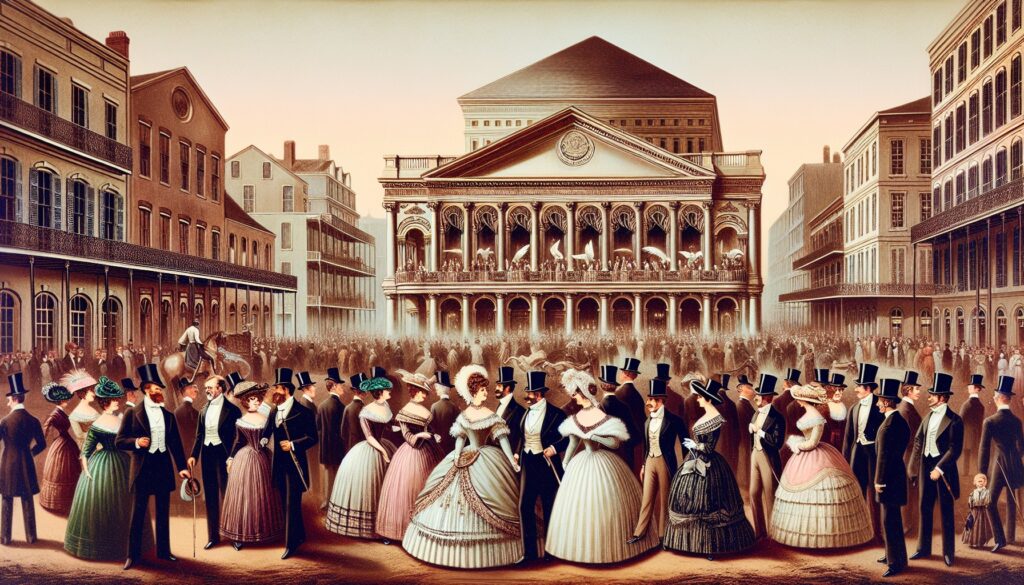
May-Day Festivals in New Orleans
~ Click images to view larger on a new page ~
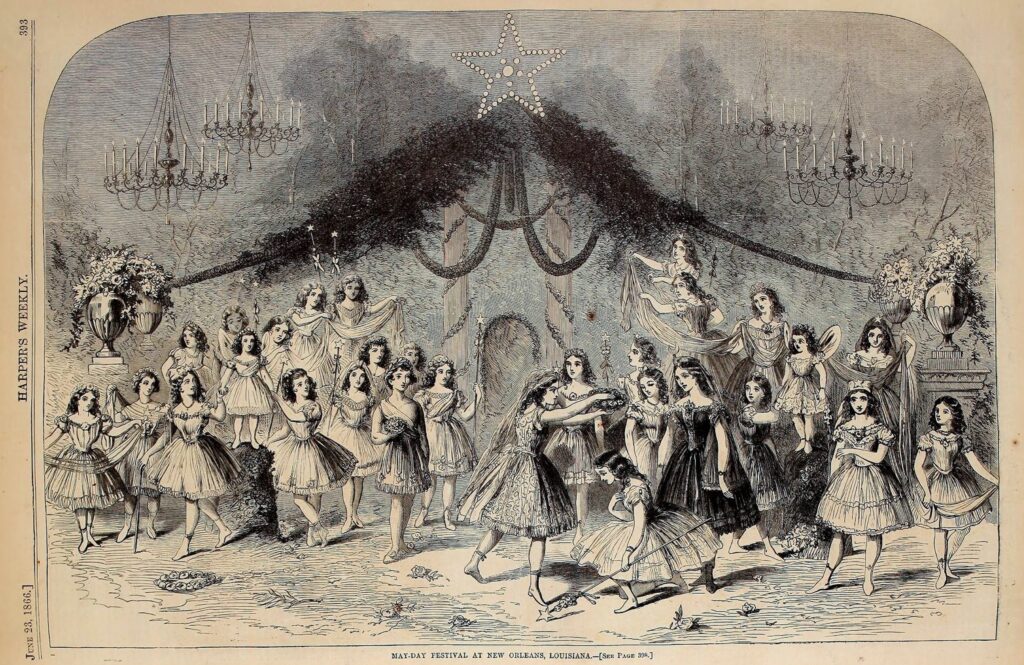
French Opera House Ballet May-Day Tableau showing the crowning of the May Queen of the Fairies. This entertainment consisted of an amateur ballet corps, and gave tableaux and fancy-dances, succeed by a ball, in which the spectators were allowed to join later that night. –Harper’s Weekly Magazine dated 23 June 1866
New Orleans has been the scene of a number of festivals during the present month, in honor of May and flowers.
The Germans have, according to time-honored custom, sweltered and guzzled lager, with additions in the shape of loud-smelling rye-bread, louder sausages, and absolutely noisy garlic and cheese; and which they danced in the hot sun, in a mob, upon a platform, perspiring happily, and causing the air to reek with recollections of the above mentioned comestibles. The Fenians have had little picnic (in peace), and other May picnics are in contemplation; but the prettiest festival was that of a dancing school- patronized. I was informed, by none but children of the ‘elite’ of New Orleans.
This entertainment came off at the French Opera-house, where the little pupils resolved themselves into an amateur ballet corps, and gave tableaux and fancy-dances, succeed by a ball, in which the spectators were allowed to join after eleven, the hour when most of the little ones went home.
The tableau selected for the sketch is the crowning of the May Queen of the Fairies by Morning, Night standing near by, and a little boy, personating Bacchus, ready to present a bouquet— although what in the name of goodness Bacchus has to do with the fairies deponent is unable to tell! Premature ‘three year olds,’ who might be the originators of all the jokes attributed to that age in the “Editor’s Drawer,’ occupied pedestals in the character of Cupids. Gas, candles, scenery, and above all, Blue-fire, made quite a pretty spectacle; the children acquitted themselves with a self confidence and ease quite remarkable. The New Orleans children are much older, so to speak than the children of the North. Those who have reached the mature age of twelve have left childhood entirely behind them, and are prepared to- and do- act the part of men and women.
Going to school at a very early age, the climate, like a hot-house, forces them quickly to maturity, but whether the average of life is so long as in less forward countries is doubtful. [1]
[1] “May-Day Festival at New Orleans Louisiana 1866,” Harper’s Weekly Magazine 10, no. 495 (1866): 398.
Washington’s Birthday in New Orleans
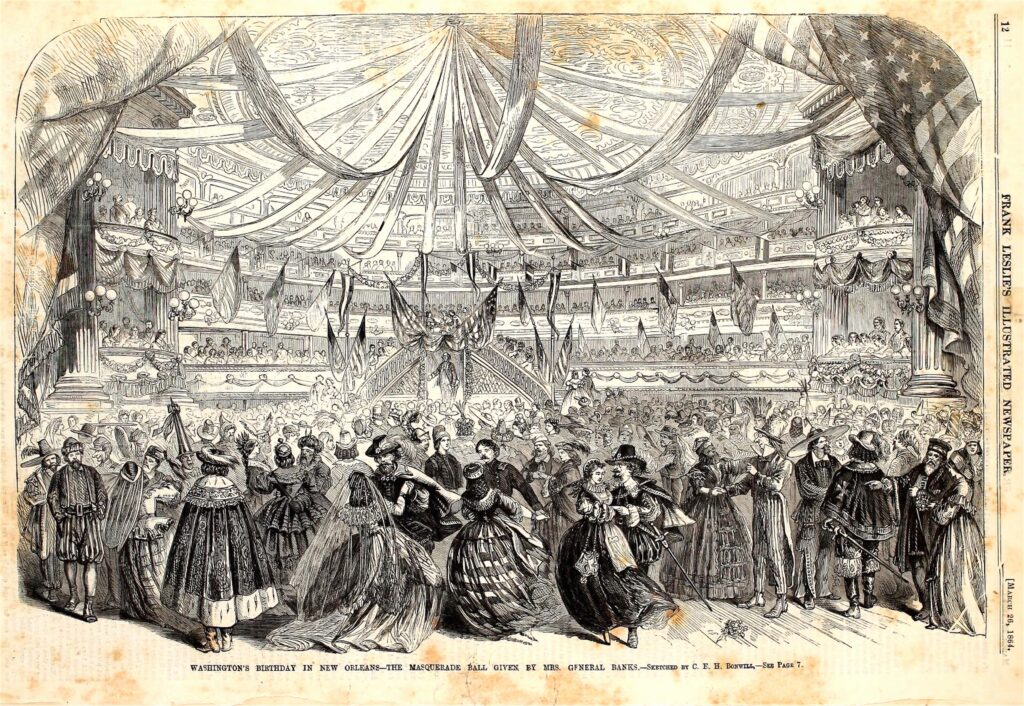
Frank Leslie’s Weekly Illustrated newspaper recounted the famous masquerade ball that Mrs. Banks gave in honor of George Washington’s birthday at the French Opera House in 1864.
The Masquerade Ball Given by Mrs. Gen Banks
“The entertainment which Mrs. Gen banks offered the elite of the New Orleans population as a proper conclusion of the glorious festivities of the day was a ball masquerade at the Opera House. The building for the occasion was most profusely decorated with flags, and further ornamented with a magnificent gas jet, forming the name of Washington. Two splendid bands, one in the second gallery and one in the rear of the stage, discoursed the music, alternately relieve each other.
At ten o’clock, the streets were alive with carriages, and occupants, in their carious and gay dresses, glistening most picturesquely in the bright moonlight, while on the pavements long processions might be seen of ladies and gentlemen, masked, wooding their way to the Opera House. New Orleans looked for the first time like an Italian rather than an American city. All was jovous, the gentlemen additionally exultant from the now officially announced Free State victory.
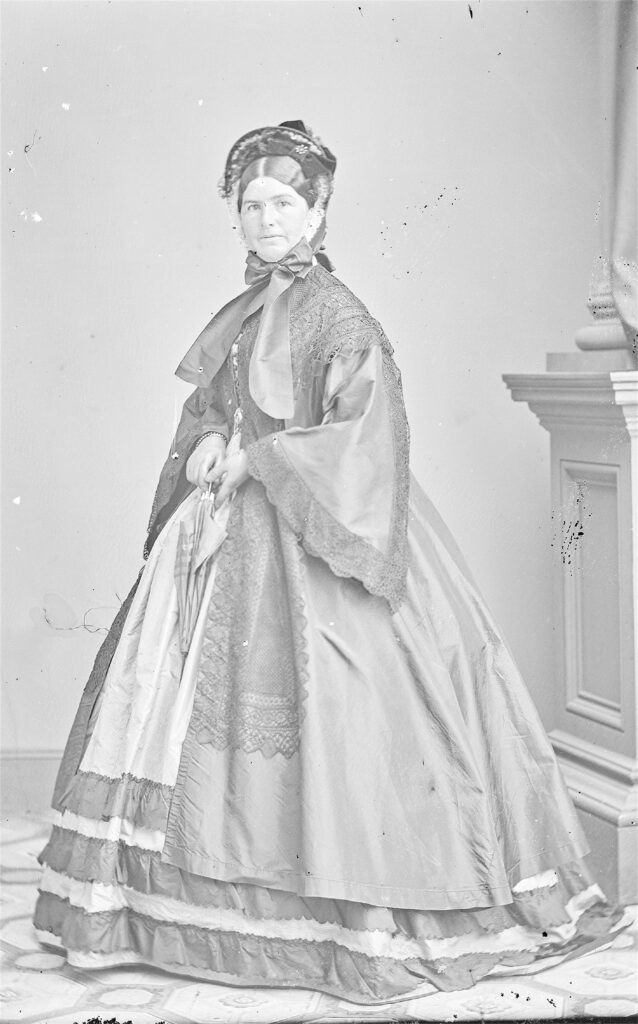
Entering the Opera House, the guests, ascending the steps, entered the building, and finally reached the first tier of boxes, where the centre of the front had been removed, and a platform erected reaching over the paraquette. From this platfrom a winding stairs descended to the floor of the ball room. On the stage stood Mrs. Gen Banks, the hostess of the evening, dresses as a lady of the era of Louis XVIII., supported on the right by a lady in the dress familiar to the dames of our first Revolutionary period, and here, supported by Gen Banks, she received her guests with dignity and ease that charmed the immense throng present.
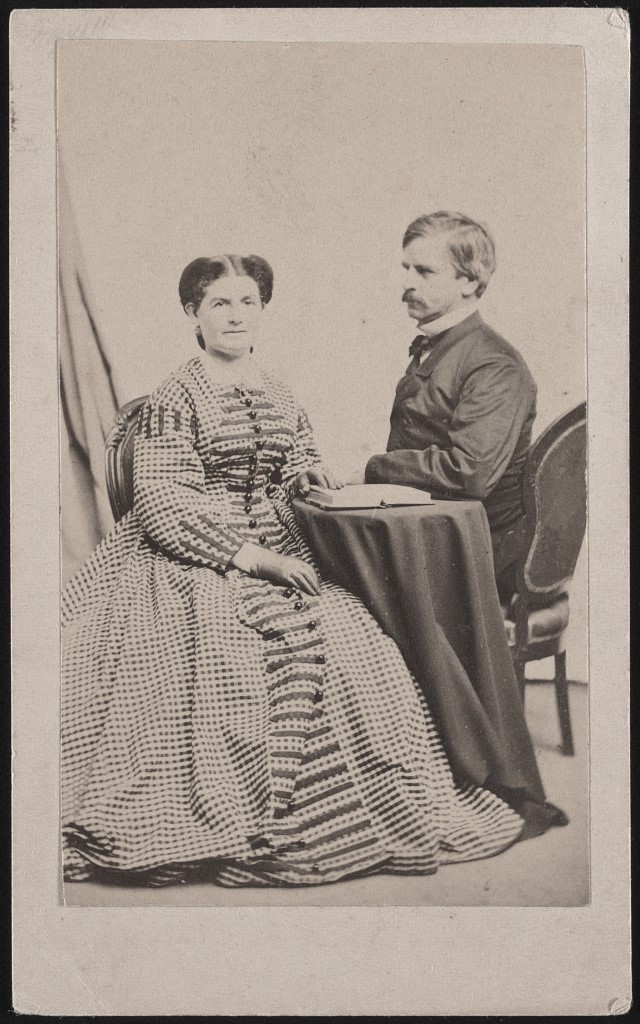
The entire affair was a most brilliant success. The boxes were crowded with elegantly-dressed spectators, the floor was overflowing with maskers, including many representatives of aristocratic families. They have withstood all inducements to be friendly and accept the Federal rule until the fascinations of social and elegant entertainments, under the patronage of Mrs. Banks, brought then from their seclusion. All were forced to admit that the Crescent City, in her palmiest days, never gave so brilliant a ball, or one in every particular so rich in costume and distinguished for its guests as this closing fete of the celebration of Washington’s birthday in New Orleans.” [1]
[1] “The Masquerade Ball Given by Mrs. Gen Banks,” Frank Leslies’s Weekly Illustrated 18, no. 433 (1864): 7.
Sunday Amusement in New Orleans- A Creole Night at the French Opera House
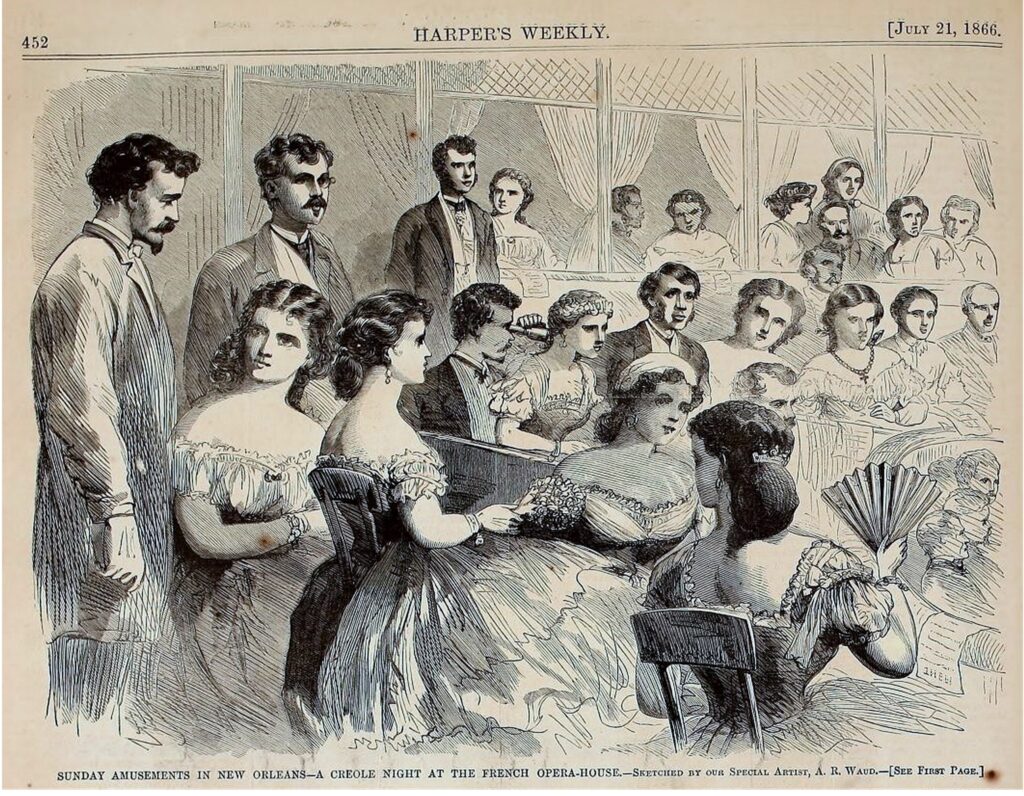
Harpers Weekly Magazine depicted a ‘Sunday at the Opera House’ in 1866 which told about the creole people attending one Sunday performance:
“The creoles- by which is usually understood the light-colored natives speaking the French language- occasionally give a theatrical entertainment at the French opera-house, where all the actors, and the greater part of audience have colored blood in their veins. These and the creole balls in the winter are considered quite “distingue” affairs and it is openly said that you will find as much or more taste in dress, as rich in jewels, and as good-breeding, as in the most aristocratic circles of New Orleans. A.R.W. “[1]
[1] “Sunday in New Orleans,” Harper’s Weekly Magazine 10, no. 499 (1866): 449.
A Creole Family at the Opera
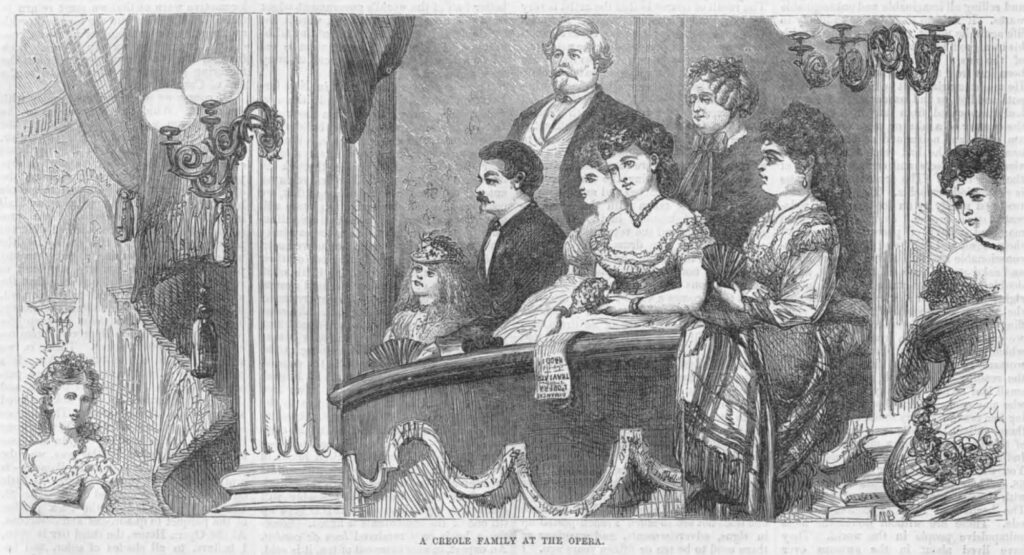
Every Saturday Weekly Illustrated Journal in the summer of 1871 described a ‘Sunday in New Orleans’ where performances were shown in the opera house in detail:
“SUNDAY is a grand festival in New Orleans, beginning early and ending late. The reader will therefore please to imagine himself up betimes and ready to start, if he cares to make a Sunday with us in this oddest of cities …
Of course we must end our Sunday with the opera. Whichever way we go to the Opera House we shall pass through the narrow, squalid streets of the French quarter, for this fine building is in the very heart of creole France. The company is supported mostly by yearly subscribers, the abonné’s of the Old World, and the whole house, arrangement, management, and all is quite, European. Omitting the proscenium boxes there are thirteen different places and prices at the choice of the white public. In buying a ticket to any part of the theatre you are supposed to subscribe to the printed contract that the management has the right to put you out, if it so desires, after refunding the money. This, I believe, is a provision to keep people with negro blood in their veins from occupying the better places. There is, we are told, a law of the State making it a penitentiary offence to expel a colored person from a hotel, bar-room, or theatre, and this printed contract on each ticket is used as an evasion of the statute. The negroes occupy the galleries of all the New Orleans theatres. In the Academy of Music – one of whose proprietors, by the way, was the proprietor of the old Floating Palace—is a private box for those who are “a little color,” as it is termed here. The St. Charles Theatre assigns the back portion of the parquet to quadroons and octoroons. At the Opera House, the third tier is open, I believe, to all shades of color, and because of the higher price seems to be occupied by the lighter and better class of the colored population.”
At the Opera- Loges Grillees
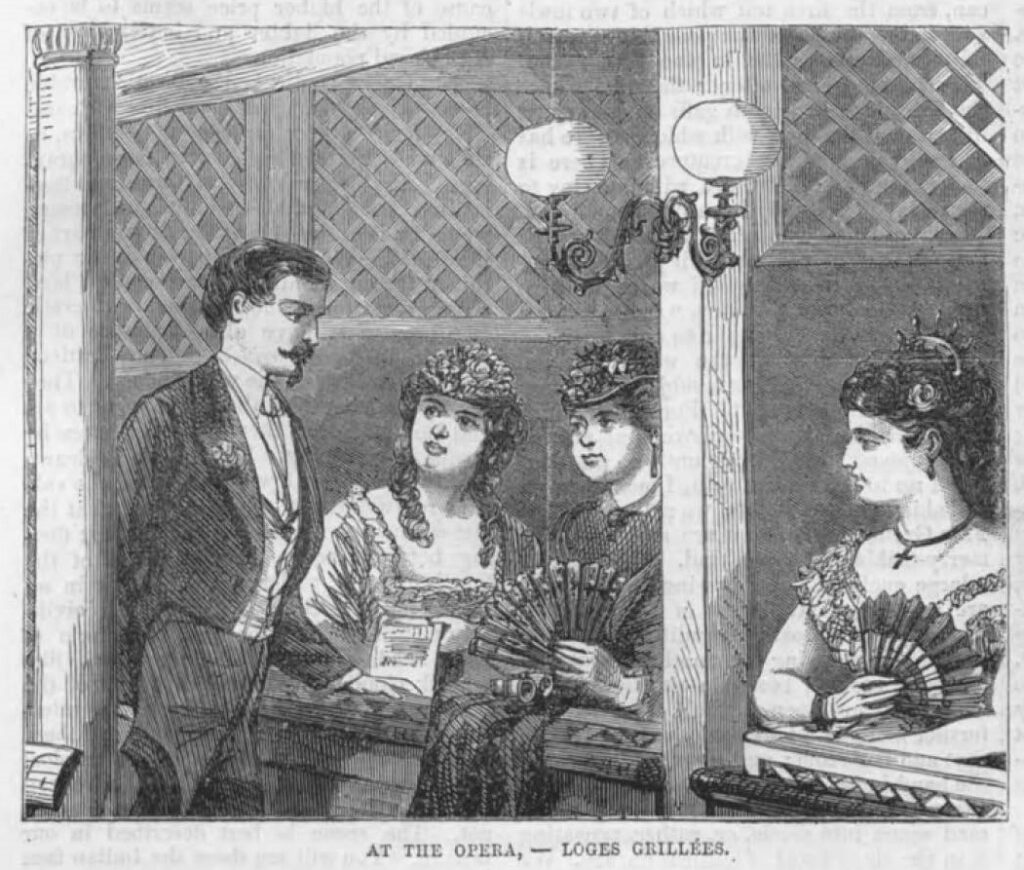
“The Opera House is the most favorable place to see the creoles of New Orleans. They have a peculiar cast of features, as we have attempted to show in our engravings. The better class of them are fine looking people, and some of the women would be considered beauties in any part of the world. We have given you in our picture of the occupants of the proscenium box, a representation of one of the old aristocratic families. You have also a picture of a stall in the loges grillées. These latticed stalls extend round the whole house. They are for the benefit of those who want to see and not be seen; they are used often by people in mourning. The lattice is drawn down upon only a few of them, and the rule is as represented in the engraving, that the fair occupants are not visible, but flirting between acts.
The opera is Traviata, which is sung much better than it is acted; but a young lady, and a very beautiful one, too, in the loge just back of us, is moved to violent weeping by the catastrophe. These good people are evidently very fond of the lyric stage, for Traviata is to be followed by an opera bouffe, and the opera bouffe by a one-act ballet, all on one evening. A single opera will be enough for us, and we will find our way out through the spacious lobbies and ante-rooms to the street, and to our beds.
There has been, of course, much gayety going on that we have not seen, -theatres, balls, processions, base-ball matches, & etc; but we have tried to see the characteristic amusements of a New Orleans Sunday.” [2]
[2] “Sunday in New Orleans,” Every Saturday Weekly Illustrated Journal 3, no. 81 (1871): 70-71.

Click here to read a firsthand account of “A Visit to the Opera House”
