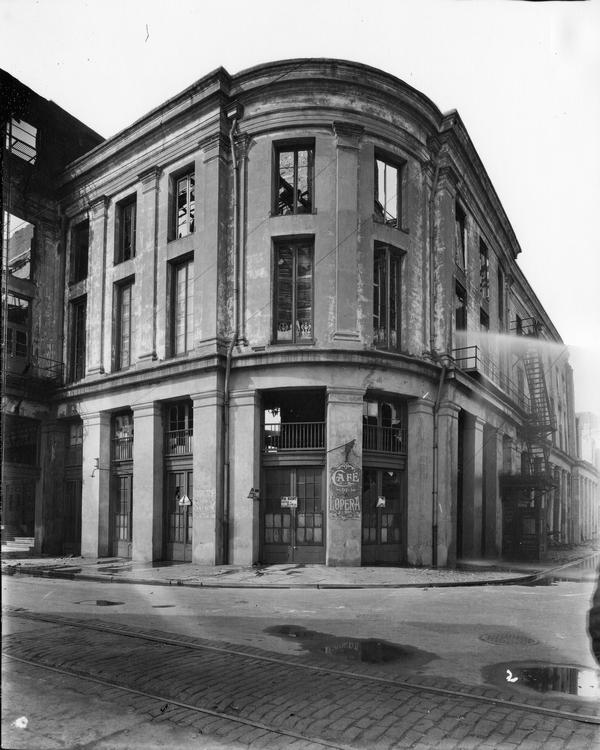
~ Click images to view larger on a new page ~
French Opera House Fire Newspaper Accounts
Opera First Produced in Orleans in 1790 and Has Continued Annually Ever Since.
by Mary M. Conway
New Orleans, Dec. 10 – The history of the French Opera House its inseparably connected with the history of New Orleans and it is impossible to rehearse one and omit the other. The desire of the early settlers to reproduce in the land of their adoption the culture and beauty they so regretfully left behind them in the old land from which they came urged them as soon as the actual necessities of living had been provided for to bring again into their lives the inspiration of the drama, art and music so large a part of the lives of the people they were accustomed to associate with in France.
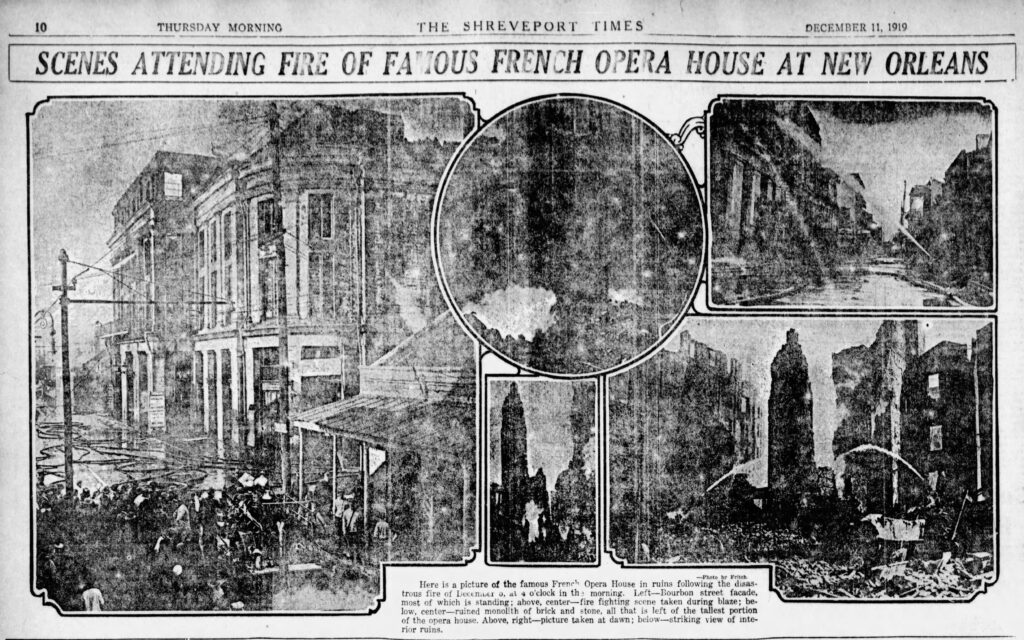
As early as 1791, the year Rossini was born and Mozart died, in the Theatre St. Pierre a regular company of singers from France produced drama, opera and ballet for several seasons; the Theatre St. Phillipe and the Theatre Orleans succeeded this house of opera and the drama as a meeting place for the music lovers and society in general. Owing to a controversy over this house in which the heirs of John McDonogh, the school philanthropist of New Orleans, were the party of the second part, a plan to erect a new and more beautiful opera house was agitated in March, 1859, and in the early part of June, in the same year, work was commenced on the new building. It was backed by a number of the wealthy citizens of that period.
Work Night and Day.
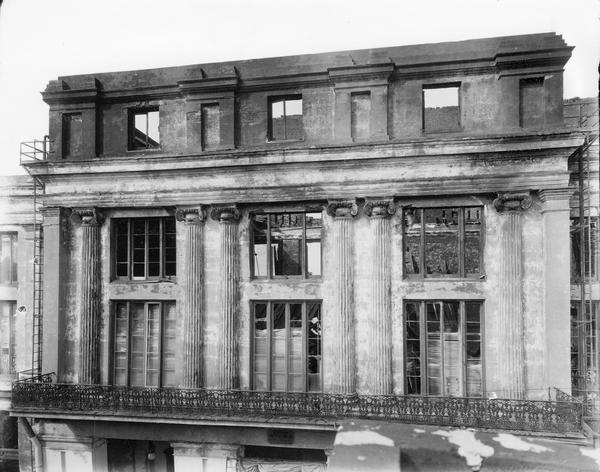
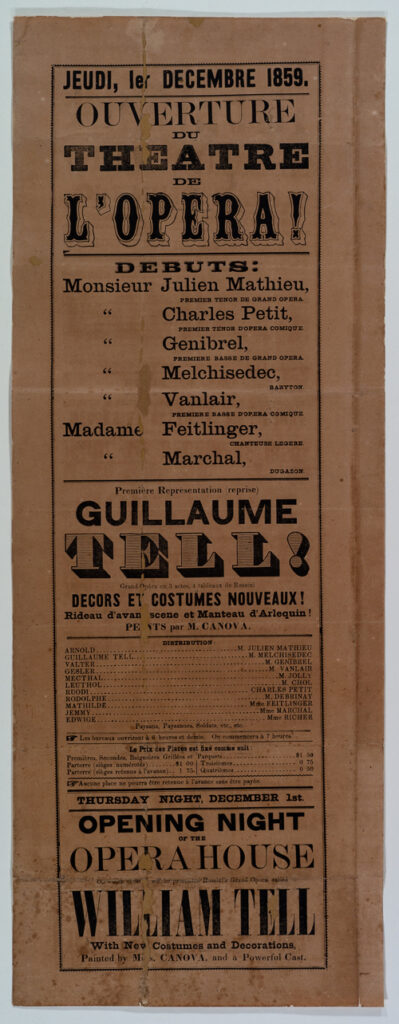
In order to have the house ready in time for the opening of the social season work went on night and day. To do this permission was obtained from the city authority’s to keep large fires burning at Toulouse and Bourbon all night. In five months the French Opera House was completed, that is on November 28, and on December 1, 1859 (three days later) opened its doors for the first time and the opera “William Tell,” was presented to a most brilliant audience.
A very brief record of the Theatre d’ Orleans would fill volume. The The cast included such fine singers as Mathieu (tenor), Melchisedes (baritone), Genibrel (basso), and Feitingoi (soprano). For several reasons distinguished audiences gathered in this and occasionally in the old Theatre Orleans to hear the splendid voices brought from Europe to delight the music lovers here.
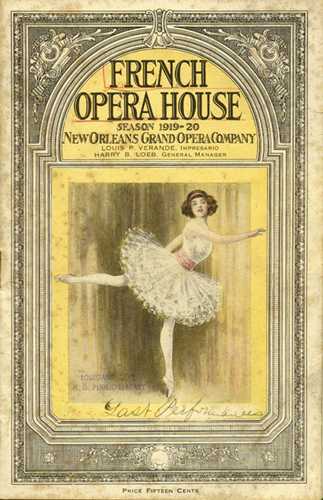
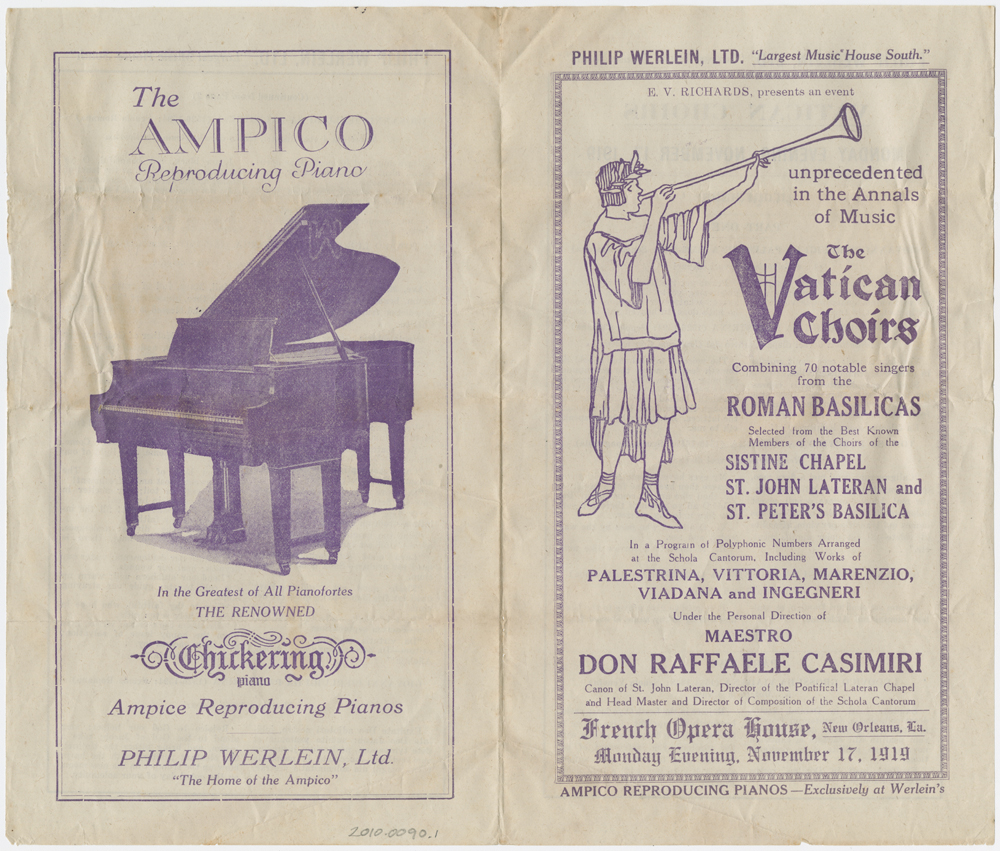
Note for Program Image: The program for the New Orleans Grand Opera Company’s final season at French Opera House, 1919-1920. The company’s final performance was Meyerbeer’s Les Huguenots.
Theatre Orleans Burns.
In December 1866, the old Theatre Orleans burned and from this time on all the significant operatic events of the French-Spanish city took place in the house destroyed Thursday. From its foundation up to this season, from season to season, with but few interruptions, those who occupy the boxes ere descendants of the men and women who lent their financial support to the old Institution in the early days of the French-Spanish occupation.
Paris Opera House was the recruiting ground for New Orleans, and each year the manager would visit Paris and replenish his company, as well as to induce a few stars of European renown to cross the Atlantic. Mr. Davis prided himself on giving grand opera in a style worthy of the opera houses of Europe, and under his management the masterpieces of Rossini, Meyerbeer, Auber, Donizetti, Mozart, Spontini and Mehul were rendered in faultless manner.
The Vatican Choirs were the 70 best singers from various basilicas in Rome and they performed at the French Opera House in New Orleans.
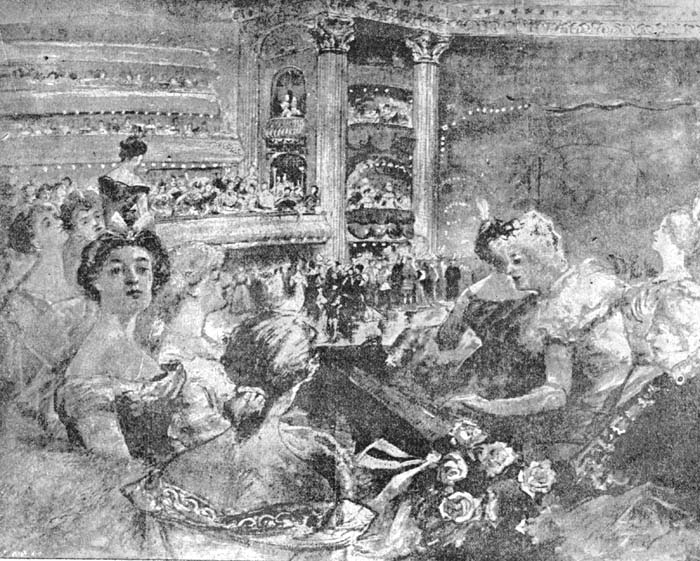
In 1845, this theatre was remodeled and greatly beautified, and had a seating capacity then of 1,350 person. Here is was that the renowned New Orleans pianist, Louis Moreau Gottschalk, gave his concerts, at $5 a seat the house was always crowded. Here, too, it was that New Orleans opera lovers heard for the first time many favorite operas.
Rigoletto Here First.
Many of the most celebrated operas were produced for the first time in American in New Orleans. Among these were operas as “Rigoletto” sung by Patti here in 1861, “Samson and Delilah,” and many others.
[1] Mary M. Conway, “N.O. and Opera History Linked” The Shreveport Times (Shreveport, LA), Dec. 11, 1919.
NEW ORLEANS’ FRENCH OPERA HOUSE BURNED.
FAMOUS STRUCTURE, BUILT IN 1859, IS COMPLETELY DESTROYED BY FIRE
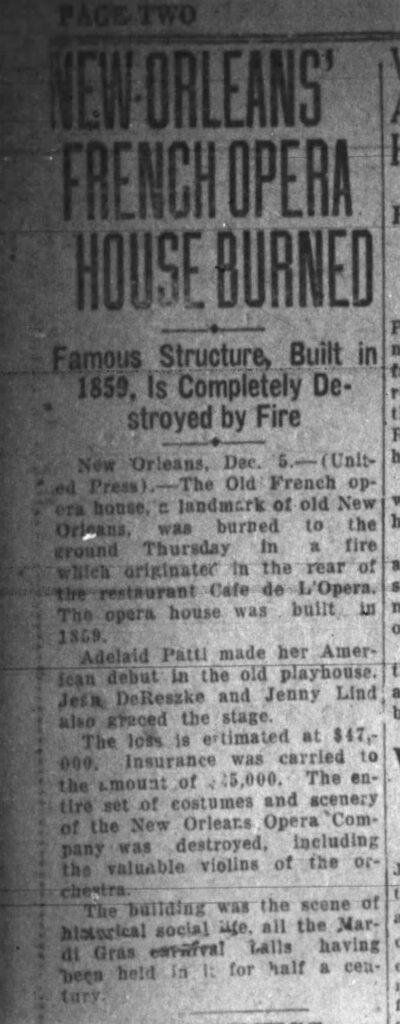
New Orleans, Dec. 5. – The Old French opera house, a landmark of old New Orleans, was burned to the ground Thursday in a fire which originated in the rear of the restaurant Cafe de L’Opera. The opera house was built it 1859.
ADELAID PATTI made her American debut in the old playhouse. MISS DeRESZKE and JENNY LIND, also graced the stage.
The loss is estimated at $47,000. Insurance was carried to the amount of $45,000. The entire set of costumes and scenery of the New Orleans Opera Company was destroyed, including the valuable violins of the orchestra.
The building was the scene of historical social life, all the Mardi Gras balls having been held in it for half a century. [1]
[1] “New Orleans’ French Opera House Burned,” The Star Anniston Alabama (Anninston, AL), Dec. 5, 1919.
