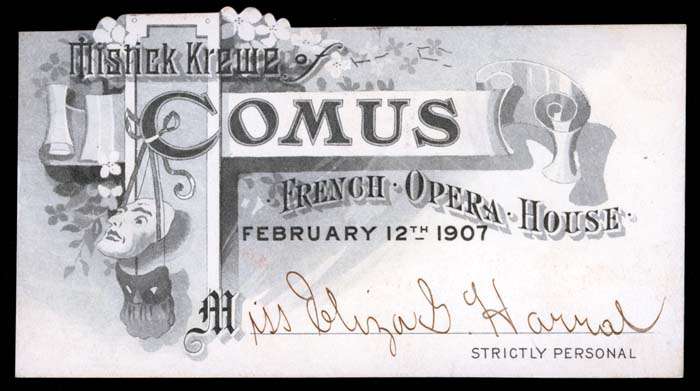
The Mystick Krewe of Comus, established in 1856, holds the distinction of being the oldest continuous Mardi Gras krewe in New Orleans and is widely credited with formalizing many of the customs that define Mardi Gras celebrations today. Founded by a group of influential gentlemen of the New Orleans’, the krewe sought to introduce a more refined and theatrical approach to Mardi Gras, which until then had been marked by relatively unstructured and boisterous street parties. Drawing inspiration from classical mythology, the krewe took its name from Comus, the Greek god of festivity, revelry, and nocturnal merrymaking. This foundation of mythological themes informed the krewe’s signature parades, which featured elaborately designed floats that conveyed allegorical stories and grand tableaux, distinguishing them from prior simpler procession styles.
In addition to the visual spectacle of the parade, the Mystick Krewe of Comus instituted private balls that were invitation-only, reinforcing a sense of exclusivity and social hierarchy, and adding an element of mystery by requiring members to wear masks and disguises. The krewe’s innovations, particularly the emphasis on pageantry, storytelling, and elaborate costume design, deeply influenced subsequent Mardi Gras organizations and helped transform the festival into a structured cultural institution with deep roots in New Orleans’ social and artistic life.
Despite the passage of time and changing social climates, the Mystick Krewe of Comus continues to play an important ceremonial role in Mardi Gras, preserving many traditions that date back to its founding in the mid-19th century.
