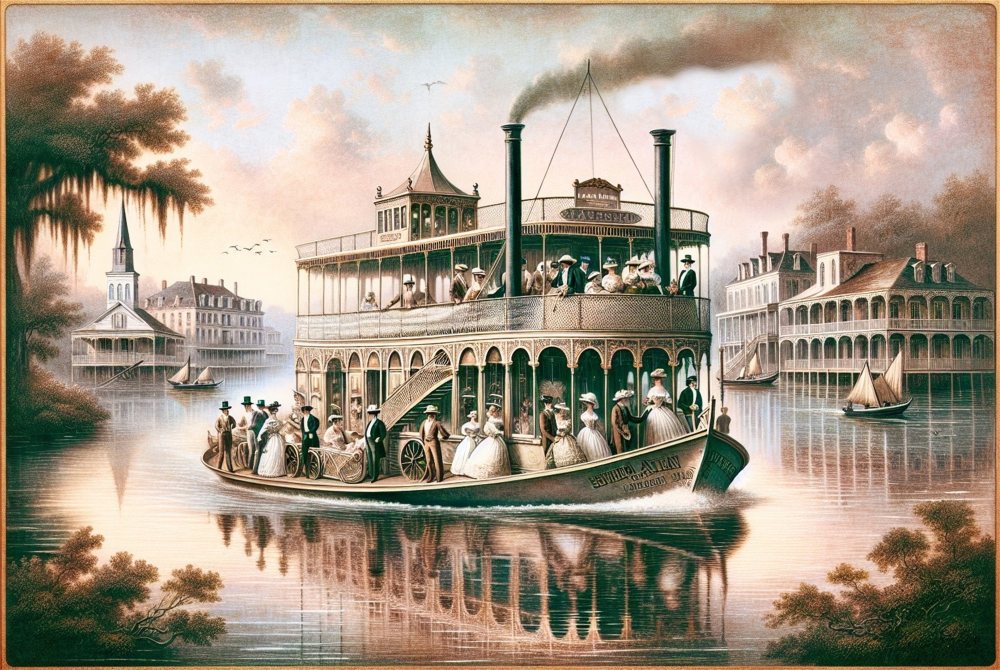
This bibliography guide provides key resources for researching the history of Natchez, Mississippi, one of the oldest European settlements in the lower Mississippi River Valley, known as “The Bluff City.” Originally inhabited by the Natchez indigenous people, part of the Mississippian culture, the area features significant Native American sites and was the starting point of the Natchez Trace, an ancient trade route.
Natchez prospered in the 19th century due to the cotton trade, becoming home to more millionaires than any other U.S. city by 1860. In the 20th century, as river commerce declined, Natchez reinvented itself as a cultural and historical museum city, boasting nearly 700 antebellum mansions—the highest concentration in the country.
The guide includes references such as the 1753 French map documenting early settlements like Fort Rosalie; encyclopedic entries describing Natchez’s development, economy, and social life; and studies of “Natchez-under-the-Hill,” known for its 18th-19th century reputation as a rough river trade district. Resources encompass books, encyclopedias, journals, and databases suitable for high school, college, or adult researchers.

This map appeared in the Memoires Historique sur la Louisiane (1753), a description of France’s Louisiana colony by Jean-Francois-Benjamin Dumont de Montigny.
The Mississippi (“Fleuve Saint Louis”) flows at the base of the map, with St. Catherine Creek (where the Natchez Indians were located) at the top a few miles to the East. Major visible features include the Grand Village (“Village Sauvage”) along St. Catherine Creek and just downstream the French settlement at “Terre Blanche.” Poorly marked but just visible near the center of the map is Fort Rosalie itself, with the house of Governor Chappard in a lower-lying area between it and the river. [1]
Map Citation:
Phillips p. 752. Background from Robert Roberts, Encylopedia of Historic Forts (1988) and Melissa Litschi, “The French Natchez Settlement According to the Memory of Dumont de Montigny” (2011).
Part I: The Basics
Natchez, also called “The Bluff City,” is one of the oldest and most important European settlements in the lower Mississippi River Valley settled over 300 years ago. The mention of this city evokes thoughts of antebellum homes, slave quarters, Indian burial mounds, and perhaps most of all the ‘Mississippi’ River which means “The Father of Waters.”
The Natchez indigenous people lived here as far back as the 8th century BC when the area was used as a ceremonial site and burial ground. The Natchez tribe were part of the Mississippian culture. The Natchez Trace, an ancient 10,000-year historic travel road that originated as a Native American trail, begins in this city and became an important trade thoroughfare for European settlers and soldiers.
During the 19th century, Natchez prospered with the booming cotton trade and attracted people from around the world seeking to profit from this economy. Natchez was receiving shipments from ports in New Orleans, St. Louis, Boston, New York, and Great Britain. Because of the great economic success of this city, half the millionaires lived here more than anywhere else in the United States by 1860.
By the 20th century, river commerce declined, and the city reinvented itself once again as a cultural and living museum of pre-Civil War America. Natchez has more antebellum mansions (nearly 700) than anywhere else in the US offering a glimpse of life in that can’t be found anywhere else. There are more of these important buildings per square mile in Natchez than anywhere else in the country.
Part II: Reference Resources
eReference Books

Subject: Natchez Under the Hill
The New Encyclopedia from the American West notes that as early as 1790s, Natchez-under-the-Hill had a reputation for wild taverns, gambling dens, and brothels. The boat trade on the Mississippi River was the center of social and economic life, so thousands of boatmen, gamblers, prostitutes, waggoners, fisherman, and frontiersmen frequented the establishments located here.
American and foreign visitors alike were shocked by what they saw. One such traveler John Bradbury commented in 1810, “For the size of it there is not perhaps in the world a more profligate place” (Kane, 1987, p. 125).
Works Cited:
Kane, H. T. (1987). Natchez on the Mississippi. New York: Bonanza Books.
Reference Citation:
Brown, R. M. (1998). Natchez – Under- The- Hill, Mississippi. In H. R. Lamar (Ed.), The New Encyclopedia of the American West. Yale University Press.
http://lynx.lib.usm.edu/login?url=https://search.credoreference.com/content/entry/americanwest/natchez_under_the_hill_mississippi/0?institutionId=3440

[Photograph by Kimberly Harrington]
Subject: Natchez
According to The Columbia Encyclopedia, the city of Natchez was settled in 1716 when Fort Rosalie was established. More in depth history is discussed from Natchez having one the largest slave markets in the South; to the city being taken by Union forces in 1863; and finally, being home to Jefferson College, Mississippi’s first charted educational college.
Reference Citation:
Natchez, City, United States. (2018). In P. Lagasse, & Columbia University, The Columbia Encyclopedia (8th ed.). Columbia University Press. Credo Reference: http://lynx.lib.usm.edu/login?url=https://search.credoreference.com/content/entry/columency/natchez_city_united_states/0?institutionId=3440

Subject: Natchez Indians
The Columbia Encyclopedia states that in 1682, there were 4,000 Natchez Indians living by St. Catherine Creek when the French first arrived. The Natchez Indians worshiped the sun and were a matrilineal society. Upon the death of a chief, his wives and guards would be strangled to death in order to accompany him into the afterlife.

In 1713, the French arrived and established a trading post. At first, relations were friendly then skirmishes took place between the two groups. The Natchez Indians massacred the French at Fort Rosalie which brought upon their eventual demise by the French. This article also details religion, agriculture, and their society.
Illustrations:
Drawings by Le Page Du Pratz (1695? – 1775) of Natchez Indians from his book Histoire de la Louisiane. This memoir tells about his years in the Louisiana colony from 1718 to 1734, when he learned the Natchez language and befriended native leaders.
Reference Citation:
Natchez, indigenous people of North America. (2018). In P. Lagasse, & Columbia University, The Columbia Encyclopedia (8th ed.). Columbia University Press. Credo Reference: http://lynx.lib.usm.edu/login?url=https://search.credoreference.com/content/entry/columency/natchez_indigenous_people_of_north_america/0?institutionId=3440
Subject: Natchez

[Photograph by Kimberly Harrington]
Cultural Studies: Holidays Around the World describes the Natchez Spring (March-April) and Fall (October) Pilgrimages as being held since 1932. This event attracts about 75,000 people to tour the antebellum homes with gardens of azaleas and camellias. One such unique home is Longwood Plantation, which is the largest octagonal house in the United States. A brief history of Natchez and more information on the pilgrimage is detailed.
Reference Citation:
Natchez Spring and Fall Pilgrimages. (2018). In P. Jaikumar (Ed.), Holidays around the world: detailing more than 3,400 observances from all 50 states and more than 100 nations: a compendious reference guide to popular, ethnic, religious, national, and ancient holidays, festivals, celebrations, commemorations, holy days, feasts, and fasts, including contact information and websites. Supplemented by special sections on words relating to time, calendar systems, phases of the moon, the world’s major living religions, facts about the U.S. states and territories, legal holidays by state, facts about the U.S. presidents, facts about countries around the world, legal holidays by country, tourism information sources; and by an annotated bibliography and chronological, historic, folkloric, calendar, promotional, sports, and subject indexes (6th ed.). Omnigraphics, Inc. http://lynx.lib.usm.edu/login?url=https://search.credoreference.com/content/entry/hfcwd/natchez_spring_and_fall_pilgrimages/0?institutionId=3440
Print Reference Books

Author James A. Crutchfeld’s The Natchez Trace: A Pictorial History is one of the best historically accurate books I have found on the Natchez Trace documenting its 10,000-year history. It contains exceptional maps, illustrations, and photographs that add so much to the story of a path traveled by so many. The best book I have ever found on the Natchez Trace.
Reference Citation:
Crutchfield, James A. (1985). The Natchez Trace: A Pictorial History. Rutledge Hill Press.

Author Harnett Kane of Natchez on the Mississippi writes from his journalist view the best stories of Natchez history. The stories he recounts tell of the famous Scottish Scientist Sir William Dunbar; John A. Quitman (Governor of Mississippi.); Surget Family of Natchez (Pirate to Patriarch); Varina Howell and Jefferson Davis; Andrew Jackson and his beloved Rachel; and the famous Goat Castle. Descriptions of many antebellum mansion homes and the stories of the families that built them are also included. This is one of my favorite Natchez history books.
Reference Citation:
Kane, Harnett Thomas. (1987). Natchez on the Mississippi. New York: Bonanza Books.
Databases

Katherine Grafton Miller, founder of the Natchez Spring Pilgrimage in 1932, and her father Major Thomas Grafton co-wrote Natchez of Long Ago and the Pilgrimage. “The History of Natchez” chapter was written by Major Grafton who was the editor of the Natchez Democrat newspaper for many years. Mrs. Miller penned the “The History of the Natchez Pilgrimage” chapter which is filled with photographs. This is a must read for anyone interested in learning more about the history of Natchez.
Reference Citation:
Miller, K. Grafton. (1938). Natchez of Long Ago and the Pilgrimage. Natchez, Miss.: The Rellimak publishing company. https://babel.hathitrust.org/cgi/pt?id=nnc1.ar62488317&view=1up&seq=5&skin=2021

This book Proud Old Natchez: History and Romance was written as a souvenir for the public in 1909 when President William H. Taft came to visit this historic city. The preface of this book explains that it wanted it to embody some interesting information on the history of Natchez. This small book recounts stories of the brave Natchez Indians, Andrew Jackson, the Old Natchez Trace, Celebrated Duels, and first-hand accounts of the bombardment of Natchez during Civil War in 1862, just to name a few. Chapter 10 also contains an interesting timeline historical chronology of important events.
Reference Citation:
Reber, Thomas [from old catalog]. (1909). Proud old Natchez: History and Romance. Natchez, Miss: [Natchez Printing and Stationery Co.]. https://babel.hathitrust.org/cgi/pt?id=loc.ark:/13960/t9h42122b&view=1up&seq=1&skin=2021
Part III: Online Resources
Journal Articles

[Photograph by Kimberly Harrington]
Title: “The Natchez Trace”
Journal: Tennessee Historical Magazine
This article on the Natchez Trace tells its relationship with the Mississippi River. Author Cotterill remarks that the Mississippi River commerce was a one-way trade; before the invention of the steamboat there was no practicable method of up-river navigation. After cargoes were sold at New Orleans, the boat had to be sold as is or just for lumber. The crew or boatmen had to find their way back up-country and many of them took the Natchez Trace. Interesting facts are discussed in this journal article.
Reference Citation:
Cotterill, R. S. (1921). The Natchez Trace. Tennessee Historical Magazine, 7(1), 27–35. http://www.jstor.org/stable/42637460

Title: “Indian Country to Slave Country: The Transformation of Natchez during the American Revolution”
Journal: Journal of Southern History
The Journal of Southern History article chronicles how the landscape changed in Natchez after the American Revolution and how relations also changed with the Indian population. American settlers expanded their plantations and took more of the Indian’s lands, hence deteriorating relations with the Indians. This article also points out that the Spanish enforced laws against Indian slavery while strengthening African slavery. Great research article on the changing landscape and society.
Image Citation:
Mattmahan. (2020, October 11) Main House.jpg. [Photograph]. Wikimedia Commons. https://commons.wikimedia.org/wiki/File:Main_House.jpg (*Image changed visually)
Reference Citation:
Layton, B. (2016). Indian Country to Slave Country: The Transformation of Natchez during the American Revolution. Journal of Southern History, 82(1), 27–58. https://doi-org.lynx.lib.usm.edu/10.1353/soh.2016.0002.

Title: “Now Occupied for Public Use: The Houses of Natchez behind Enemy Lines”
Journal: Southern Quarterly
This Southern Quarterly article tells of firsthand accounts from letters and diaries from Union occupation during the Civil War in the summer of 1863. A great primary source of material on the history of Natchez during the Civil War.
Illustration Citation:
“Union troops land and occupy Natchez, Mississippi, July 13, 1863, artist’s impression, detail,” House Divided: The Civil War Research Engine at Dickinson College, https://hd.housedivided.dickinson.edu/index.php/node/40678.
Reference Citation:
Mansell, J. (2013). Now Occupied for Public Use: The Houses of Natchez behind Enemy Lines. Southern Quarterly, 51(1/2), 73–92. https://search-ebscohost-com.lynx.lib.usm.edu/login.aspx?direct=true&db=aph&AN=95409507&site=ehost-live
Web Sites
This educational website is on the historic Fort Rosalie and its archaeology history. The fort’s description is also included as an “irregular pentagon, without bastions, and built of thick plank. The buildings within consisted of a stone house, magazine, houses for the officers and barracks for the soldiers.” More insight is given into the events that led to the massacre.
Historic Natchez. (2021). Natchez.org. https://natchez.org/education/historic-natchez
The Historic Natchez website contains many educational links where you can learn more about this city. You learn about the history of the town’s older buildings through photographs as well historical figures. Many wonderful historical images with excellent descriptions.
Other Media

Reference Citation:
Bluff at Natchez, Miss. United States Mississippi Natchez, None. [Photographed 1864, printed between 1880 and 1889] [Photograph] Retrieved from the Library of Congress, https://www.loc.gov/item/2012649398/.

Reference Citation:
Detroit Publishing Co, P., Jackson, W. H., photographer. Natchez, Under the Hill and the Miss. United States Mississippi River Natchez, None. [Between 1885 and 1898] [Photograph] Retrieved from the Library of Congress, https://www.loc.gov/item/2016802898/.
The Historic Natchez Tableaux is a completely local and volunteer cast that brings to life the folk dances, pastimes, and pageantry of Natchez history. Dances such as the Virginia Reel, Maypole Dance, and the Polka are featured in this lively program. This program gives you a glimpse into the history and social life of Natchez in the 18th and 19th century.
(Tableau -from French, literally, living picture: a depiction of a scene usually presented on a stage by silent and motionless costumed participants. Tableaux – plural.)
Reference Citation:
Mayer, Jerry. (2012, March 27). Historic Natchez Pilgrimage Tableaux [Video]. YouTube. https://www.youtube.com/watch?v=HqNDt-2xahs
A short Natchez National Historical video on how Katherine Grafton Miller became the founder of the Natchez Spring Pilgrimage which has become the second oldest home tour in America.
Reference Citation:
Natchez National Historical Park. (2016, March 31). Mar 31 Katherine Grafton Miller [Video]. You Tube. https://www.youtube.com/watch?v=hrsmgDGPZDc

Reference Citation:
Thomas H. and Joan W. Gandy Photograph Collection, Cameras and Equipment Subgroup, Mss. 3778, Louisiana and Lower Mississippi Valley Collections, LSU Libraries, Baton Rouge, Louisiana
James A. FitzPatrick’s Travel Talks ~ The Voice of the Globe short entitled Old Natchez on the Mississippi (1939) focuses on the city’s preservation of the architecture, apparel, and customs of the antebellum South. In this film, the city’s antebellum days is the focus as they show the Natchez Garden Club restoring old homes and the spring pilgrimage featuring costumes, song, and dance to celebrate the old South. A visit to Connolly’s Tavern and three mansions: Edgewood where costumed children play, Englewood with its echoes of Jenny Lind, and Melrose where ladies and gents dance. The romance of days before the Civil War is highlighted.
Part IV: Summary
Natchez’s historical importance consists of its indigenous Natchez people, the starting point of the ancient Natchez Trace trade route, and its central role in 19th-century Southern commerce. The city flourished as a prosperous cotton-trading center and preserved its history with scores of antebellum homes and cultural spectacles, exemplified by the Spring and Fall Pilgrimages. This bibliography draws on the best scholarly books, articles, maps, websites, and multimedia to assist high school, college, or adult scholars who want to explore Natchez’s complex history: from Native American culture and French settlement through Civil War occupation and historic preservation.
